
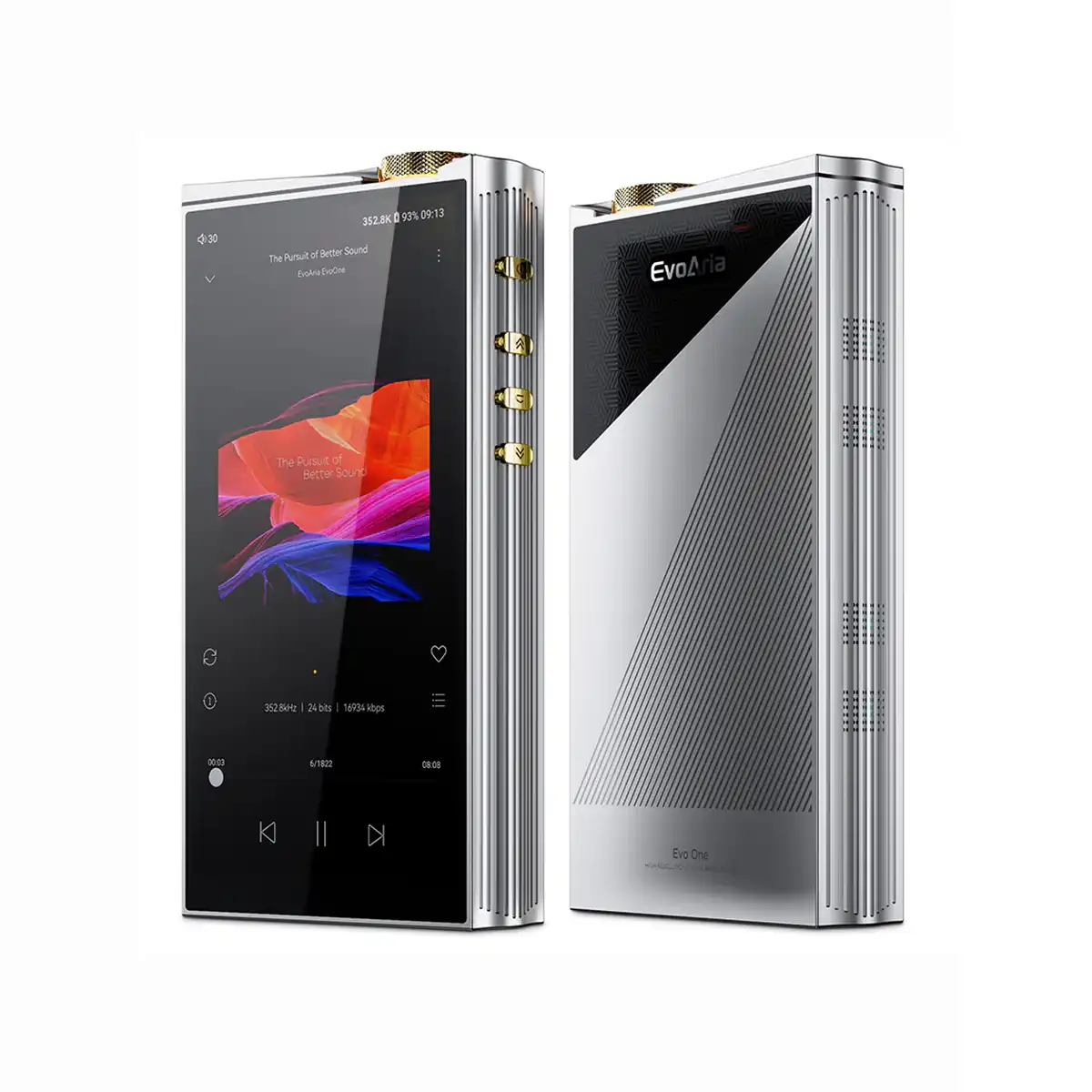


Reference Digital Audio Player with Hybrid Tube Architecture and Fully Discrete Amplification
With the Evo One, EvoAria introduces a no-compromise reference digital audio player engineered around absolute signal integrity, architectural flexibility, and extreme power reserves.
At its core lies a sophisticated parallel differential DAC architecture built around two AK4191EQ modulators and four AK4499EXEQ DACs operating in true mono mode — combined with a fully discrete amplifier stage and a unique triple analog output architecture.
The Evo One is not simply a flagship DAP. It is closer to a transportable reference preamplifier with selectable tube or pure transistor amplification.
Parallel Differential Quad-DAC Architecture
The digital stage consists of:
- 2 × AK4191EQ digital modulators
- 4 × AK4499EXEQ DACs (each operating in MONO mode)
- Eight-channel I/V conversion topology
- True dual-mono power architecture
Each channel is independently powered via ultra-low-noise LT3045 regulators, minimizing crosstalk and noise coupling while maximizing dynamic performance and decoding precision.
Supported formats include:
- PCM up to 768 kHz
- DSD512
- MQA 16× unfolding
Clocking is handled by dual Accusilicon AS318 femtosecond oscillators (45.1584 MHz / 49.152 MHz), delivering extremely low phase noise and exceptional temporal accuracy.
The result is expansive staging, refined micro-detail retrieval, and an exceptionally low noise floor.
Fully Discrete Amplifier Stage – Class A / Class AB with Selectable Feedback
The amplifier section is built entirely from discrete components, including audio-grade FETs and transistors, arranged in a classic three-stage topology:
- Fully symmetrical differential input stage
- Voltage amplification stage
- Power driver output stage
Users can select:
- Class A or Class AB operation
- Local negative feedback (NFB) or non-feedback mode
This flexibility allows the Evo One to adapt to different headphones, musical genres, and personal listening preferences — from smooth and fluid to highly dynamic and immediate.
Triple Analog Audio Architecture – Dual Tube Hybrid + Fully Transistor Mode
One of the defining features of the Evo One is its configurable analog output stage.
Hybrid Tube Mode – Dual KORG Nutube 6P1
Two KORG Nutube 6P1 vacuum tubes form a fully analog hybrid signal path in combination with the discrete amplification stage.
Two tonal profiles are available:
Velvet A warm, velvety presentation with a stronger concentration of even-order harmonics. Ideal for intimate vocals, jazz, acoustic recordings, and emotionally rich material.
Lumina Clear, luminous, and well-defined, with a more evenly distributed harmonic structure. Offers versatility across a wide range of genres.
Additionally, the screen-grid voltage of the Nutube can be switched between High and Low, allowing further refinement of tonal density and dynamics.
Fully TR Mode – Pure Transistor Operation
In FULLY TR mode, the tube stage is completely bypassed.
This configuration emphasizes:
- Maximum speed
- Exceptional transient response
- Superior dynamic control
- High precision with complex orchestral or large-scale recordings
Switchable Line-Out and Pre-Out
Both Line-Out and Pre-Out can operate in either Hybrid or Fully TR architecture.
This enables seamless integration into:
- Desktop amplifier systems
- Active speaker setups
- Automotive audio systems
- External power amplifiers
The Evo One becomes a versatile control center without compromising sonic performance.
Power Architecture – A Power-First Philosophy
EvoAria designed the Evo One around an uncompromising power foundation:
- 10,000 mAh high-capacity battery
- Farad-level ELDC supercapacitors with ultra-low ESR
- Dual LT8334 regulator architecture
- 16 parallel Panasonic low-ESR polymer capacitors
- Extensive multi-stage LDO regulation
This ensures stable voltage delivery under extreme dynamic load, preventing compression, distortion, or transient collapse.
Exclusive Battery Bypass Mode
When connected to an external PD power supply (≥ 9V), users can activate DC mode via the interface.
In this mode, the battery is completely bypassed, allowing the unit to operate directly from external power — ideal for long-term desktop use while preserving battery longevity.
Modern Platform Performance
- Qualcomm QCS8550 platform (8 Gen 2-level performance)
- 16 GB RAM
- 512 GB internal storage
- microSD support up to 2 TB
- Android 13 with full Google framework support
- Global DTA lossless audio output
Display:
- 5.99” BOE In-Cell FHD+ (1080 × 2160, 18:9)
- Corning Gorilla Glass 5
- Multi-touch, double-tap wake, gesture control
Wireless:
- Bluetooth 5.3
- Wi-Fi 7
- UAT (up to 192 kHz)
- LDAC (up to 96 kHz)
- SBC / AAC
- Bidirectional USB audio up to PCM 768 kHz / DSD512
Evo One Titanium (Ti)
Constructed from aerospace-grade TC4 titanium alloy with PVD treatment Weight: approx. 575 g
Sonic Character
Expansive soundstage, strong macro-dynamics, excellent transient attack, and refined extension at both frequency extremes with clear, layered imaging.
Advantages
- Lower weight
- High structural strength
- Excellent scratch and wear resistance
- Refined, cool metallic aesthetic
Consideration: Slightly reduced heat dissipation compared to the Copper version, resulting in marginally longer charging times.
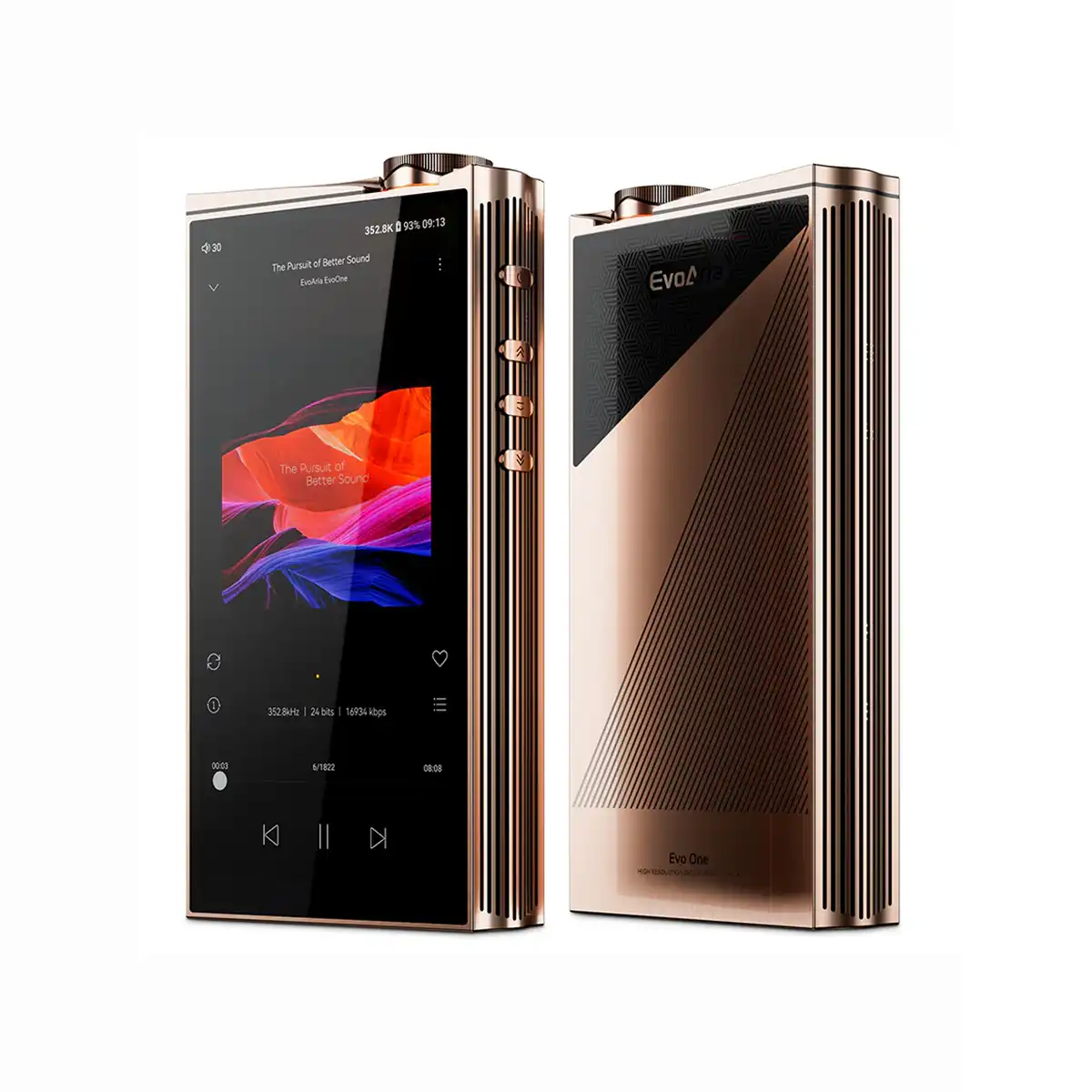
Evo One Copper (Cu)
Brass chassis with vintage copper coating Weight: approx. 740 g
The high electrical conductivity of the brass chassis creates a powerful grounded shielding structure, significantly reducing electromagnetic interference and providing ultra-low impedance return paths.
Sonic Character
Exceptional speed and transient precision, wide and natural staging, rich harmonic overtones, and deep, powerful, structured bass response.
Advantages
- Superior heat dissipation
- Approximately 30 minutes faster charging
- Enhanced EMI resistance
Consideration: Higher weight and softer material require more careful handling.
Internal Structure & Thermal Management
The Evo One features a multi-chamber internal layout separating battery, tube stage, and main circuitry to minimize interference.
A fully enclosed silicone damping system suppresses microphonic vibration from the Nutube tubes, improving stability and refinement.
Thermal management combines:
- Aluminum alloy support frame
- Graphene sheets
- Thermal silicone materials
- Nickel silver components
This ensures efficient heat distribution and stable long-term operation under sustained load.
Đang cập nhật
Đang cập nhật










.png)